Introduction
Businesses are increasingly using the cloud—platforms like Amazon Web Services (AWS), Microsoft Azure, and Google Cloud Platform (GCP)—to store data, run applications, and grow quickly. The cloud offers speed, flexibility, and cost savings, but it’s not automatically secure. Think of it like renting a high-tech apartment: the building might be sturdy, but you still need to lock your doors and protect your belongings. Securing what you build and store in the cloud is your responsibility, not the cloud provider’s (Aztech IT Solutions, 2024).
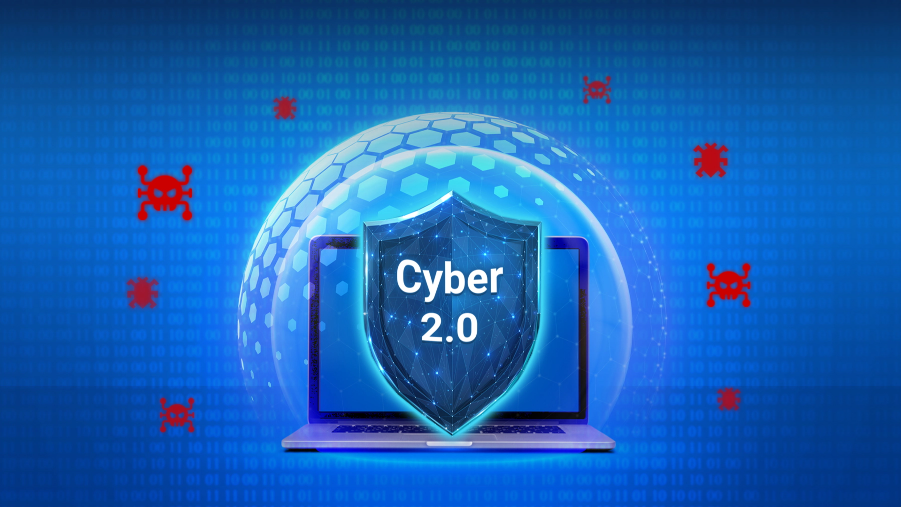
This article explains why cloud security is critical, highlights common risks, and shares simple ways to protect your cloud environment using modern tools like Cyber 2.0, which are designed to keep up with today’s fast-moving threats.
Why the Cloud Is a Bigger Target
The cloud’s ability to handle huge amounts of data and its widespread use make it a prime target for hackers. Businesses often update their cloud applications daily or even hourly, which can lead to mistakes like:
- Misconfigured Access Controls: Giving too many people or apps access to sensitive data.
- Exposed APIs or Containers: Leaving parts of your app open to the internet.
- Unprotected Storage Buckets: Storing data in places anyone can access.
- Shadow IT: Employees using unapproved cloud apps without IT’s knowledge.
These errors create openings for cyberattacks. For example, in 2024, a retail company exposed 1.2 million customer records because an Amazon S3 storage bucket was left publicly accessible, allowing hackers to steal names, emails, and order details (Wiz, 2024). In the Philippines, 84% of organizations reported at least one breach in 2024, with an average of 3.13 incidents each, often due to such misconfigurations (PhilSec Summit, 2025). Globally, data breaches cost businesses an average of $4.88 million in 2024, partly because data is spread across multiple systems, making it hard to protect everything (IBM & Ponemon Institute, 2024).
| Common Cloud Risk | What it Means | Why it's Dangerous |
|---|---|---|
| Misconfigured Access Controls | Too many people have access | Hackers can steal data easily |
| Exposed APIs/Containers | App parts open to the interner | SAllows unauthorized access |
| Unprotected Storage Buckets | Data stored without locks | Anyone can view or steal it |
| Shadow IT | Unapproved apps used by employees | Bypass security controls |
Why Traditional Security Struggles in the Cloud
Traditional security tools, like firewalls and antivirus programs, were designed for simpler times when all data was stored in one place, like a company’s office servers. But today’s networks are like busy cities with many moving parts:
- Mix of Old and New Systems: Some parts are modern cloud apps, while others are older servers that may not have the latest security features.
- Remote Work: Employees connect from home, coffee shops, or public Wi-Fi using laptops, phones, or even smart devices like IoT gadgets.
- Evolving Threats: Hackers use advanced methods like fileless malware (attacks that don’t use traditional virus files), identity hijacking (stealing login credentials), and lateral movement (moving between cloud systems).
These complexities make it hard for traditional tools to keep up. For example, in April 2024, hackers stole 2 terabytes of research data from the Philippine Department of Science & Technology (DOST) because its outdated systems couldn’t stop modern attacks (Jose, 2024). Similarly, in early 2025, Oracle Health had a breach where attackers stole patient data from an old server not yet moved to the cloud (BleepingComputer, 2025). In 2024, Jollibee, a major fast-food chain in the Philippines, faced a breach affecting 11 million customers, with stolen data sold on the dark web (Malik, 2024). These incidents show that weak or outdated parts of a network can put the entire business at risk.
A Smarter Way to Protect Your Cloud
To stay safe, businesses need security tools built for the cloud’s complexity. Modern solutions, like Cyber 2.0, use advanced techniques to protect your data and apps:
- Zero Trust Approach: Nothing is trusted until proven safe. Every user, device, and connection must verify itself, reducing the risk of unauthorized access.
- Chaos Engine: This scrambles how your network communicates, like a constantly changing puzzle. Hackers can’t navigate it, but your approved apps and users can.
- Real-Time Monitoring: It watches for suspicious activity and stops threats instantly, even if they’re new or unknown.
- No Constant Updates: Unlike traditional tools that need regular updates to recognize new threats, Cyber 2.0 blocks anything not explicitly allowed.
- Works Everywhere: It protects cloud systems, office servers, and remote devices in one unified system.
Cyber 2.0 claims to stop all types of cyberattacks by making it nearly impossible for hackers to move around your network, even if they get in (Cybersecurity Intelligence, n.d.). While this is promising, more real-world testing is needed to fully confirm its effectiveness.
| Cyber 2.0 Feature | How it Helps | Why it's Different |
|---|---|---|
| Zero Trust | Verifies every device | Stops unauthorized access |
| Chaos Engine | Scrambles network communication | Confuses hackers |
| Real-Time Monitoring | Spots and stops threats instantly | Catches new attacks |
| No Updates Needed | Blocks unknown threats | Doesn't rely on virus lists |
The Rise of AI-Powered Threats
Artificial intelligence (AI) is a game-changer for businesses, helping analyze data, automate tasks, and scale operations. But hackers are using AI too, creating smarter attacks like:
- Fake emails that look real (phishing).
- Automatically finding weak spots in cloud setups.
- Launching fast, large-scale password-guessing attacks.
To fight back, businesses need security tools that use AI to spot unusual activity and stop threats in real time. Solutions like Cyber 2.0 aim to do this by adapting to new threats without slowing down your operations (CustomerThink, 2024).
What You Can Do to Stay Safe
To protect your cloud environment, follow these steps:
- Give Minimal Access: Only let users and apps have the permissions they need (Wiz, 2024).
- Check Settings Regularly: Use tools to find and fix misconfigurations, like open storage buckets (Aztech IT Solutions, 2024).
- Encrypt Everything: Lock your data with encryption when stored and sent (CustomerThink, 2024).
- Use Zero Trust: Verify every user and device, no exceptions (CISA & NSA, 2024).
- Add Multi-Factor Authentication (MFA): Require extra login steps, like a phone code (SentinelOne, 2024).
- Keep Software Updated: Update apps and systems to fix security holes (CrowdStrike, 2024).
- Divide Your Network: Split your cloud into smaller sections to limit damage if attacked (Wiz, 2024).
- Train Your Team: Teach employees to spot phishing emails and follow security rules (Astra, 2024).
Why This Matters in 2025
In the Philippines, cyberattacks are a growing problem. In 2022, the country faced 39.4 million web attacks, ranking second globally (Antivola, 2023). In 2024, 84% of organizations had at least one breach, and over 660 million records were exposed in the first half of the year alone (PhilSec Summit, 2025). Globally, the cost of breaches is rising, driven by the complexity of cloud environments (IBM & Ponemon Institute, 2024). Sticking with old tools like firewalls leaves businesses vulnerable to these evolving threats.
The Path Forward: Try Chaos for Your Organization
Cloud security is about protecting your business without slowing down innovation. Modern tools like Cyber 2.0 work quietly in the background, letting your team focus on growth. By adopting practices like Zero Trust, encryption, and regular checks, and using AI-driven tools, you can stay ahead of hackers. While no solution is perfect, combining traditional and modern defenses offers the best protection.
Let’s Talk, If you want to explore how Bastion Inc. can help secure your organization with proactive, modern cybersecurity like Cyber 2.0—let’s connect.
📩 Send us a message or visit www.bastion.inc for more details.
📰 Stay informed in today’s fast-moving digital world—You can join our Viber community by clicking the link or scanning the QR code below!
https://tinyurl.com/BASTIONCYBERCONNECT

Article by David Naga:
#cloudsecurity #cybersecurity #zerotrust #cloudcomputing #devsecops #cloudnative #ransomware #EDR #cyber20 #BastionInc #cloudinfrastructure #infosec
References
Aztech IT Solutions. (2024). 15 Essential Cloud Security Best Practices & Checklist For 2025. https://www.aztechit.co.uk/insights/cloud-security-best-practices
CISA & NSA. (2024). CISA and NSA Release Cybersecurity Information Sheets on Cloud Security Best Practices. https://www.cisa.gov/news-events/news/cisa-and-nsa-release-cybersecurity-information-sheets-cloud-security-best-practices
CrowdStrike. (2024). 11 Cloud Security Best Practices for 2025. https://www.crowdstrike.com/cybersecurity-101/cloud-security/cloud-security-best-practices/
CustomerThink. (2024). Cloud Security in 2025: Best Practices to Safeguard Your Data. https://customerthink.com/cloud-security-in-2025-best-practices-to-safeguard-your-data/
IBM & Ponemon Institute. (2024). Cost of a Data Breach 2024. https://www.ibm.com/reports/data-breach
PhilSec Summit. (2025, March 24). The Alarming State of Cybersecurity in the Philippines: Trends and Insights from 2024. https://www.philsecsummit.com/the-alarming-state-of-cybersecurity-in-the-philippines-trends-and-insights-from-2024/
SentinelOne. (2024). 20 Cloud Security Best Practices. https://www.sentinelone.com/blog/cloud-security-best-practices/
Wiz. (2024). Top 25 Cloud Security Best Practices. https://www.wiz.io/learn/top-25-cloud-security-best-practices
Antivola, M. H. L. (2023, October 26). Increasing cyberattacks prompt need for fast, frequent penetration testing, expert tells businesses. BusinessWorld Online. https://www.bworldonline.com/technology/2023/10/26/553979/increasing-cyberattacks-prompt-need-for-fast-frequent-penetration-testing-expert-tells-businesses/
Jose, A. E. O. (2024, April 4). DICT suspects domestic hackers, blames 'outdated' systems for DoST data breach. BusinessWorld Online. https://www.bworldonline.com/the-nation/2024/04/04/586003/dict-suspects-domestic-hackers-blames-outdated-systems-for-dost-data-breach/
BleepingComputer. (2025, March 28). Oracle Health breach compromises patient data at US hospitals. https://www.bleepingcomputer.com/news/security/oracle-health-breach-compromises-patient-data-at-us-hospitals/
Malik, J. (2024, July 10). Jollibee Data Breach Impacts 11 Million Customers, Affects Burger King, Panda Express, and Others. CPO Magazine. https://www.cpomagazine.com/cyber-security/jollibee-data-breach-impacts-11-million-customers-affects-burger-king-panda-express-and-others/
Cybersecurity Intelligence. (n.d.). Cyber 2.0 - Cybersecurity Intelligence. https://www.cybersecurityintelligence.com/cyber-2-0-6143.html